

Why Does Handmade Jewelry Cost More? The Real Answer
Last Updated: November 5, 2026
Quick Summary
Handmade jewelry costs more because an individual artisan cuts, shapes, assembles, and finishes each piece by hand, so you pay for real hours of skilled labor plus genuine materials like full-grain leather and solid findings. A fair retail price adds materials, labor, and overhead, then applies a markup that keeps the maker in business.
- Mass-produced pieces take minutes per piece, while handcrafted pieces take hours of handwork.
- Material cost stacks across base material, findings, finish, and packaging, and each layer raises the price.
- The pricing formula is materials plus labor plus overhead, multiplied by markup.
- Etsy listing and transaction fees belong in your overhead, not your profit margin.
- A repairable piece can cost less over years of wear than a cheap piece replaced twice.
Table of Contents
- The Real Reasons Handmade Jewelry Costs More
- Materials and Components: Where the Money Goes
- Labor, Time, and the Artisan's Hourly Rate
- The Jewelry Pricing Formula Every Maker Should Know
- Using a Jewelry Pricing Calculator to Set Fair Prices
- How to Price Handmade Jewelry on Etsy Without Underselling
- How to Price Handmade Beaded Jewelry: A Step-by-Step Approach
- How to Judge Value as a Buyer (Not Just the Price Tag)
- Frequently Asked Questions
The Real Reasons Handmade Jewelry Costs More
Pick up two bracelets that look alike and wonder why one costs three times the other. The answer sits in a workshop, not a warehouse. Why handmade jewelry costs more comes down to a simple truth: someone made that piece with their own hands, one at a time, and hands are slower than machines.
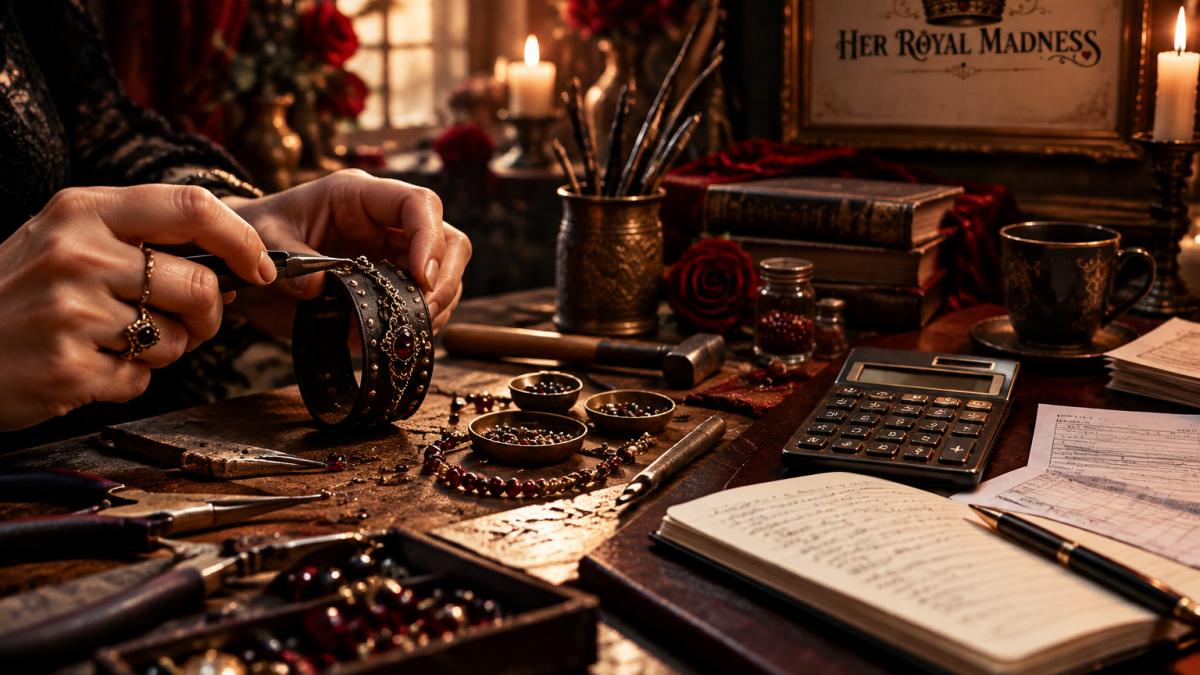
Handmade jewelry is jewelry produced by an individual artisan who cuts, shapes, assembles, and finishes each piece by hand or with small hand tools, rather than on an automated production line. That definition matters because it explains the cost structure.
Here's what most buyers get wrong: they compare two similar-looking pieces on price alone and assume the cheaper one is a bargain. Often it's a different product entirely.
Mass-Produced vs. Handcrafted: A Direct Comparison
The clearest way to see the difference is side by side. Machine-made jewelry is designed for volume: a mold or die stamps out identical components, and workers assemble them in a line.
| Factor | Mass-Produced | Handcrafted |
|---|---|---|
| Production method | Mold or die, assembly line | Cut, shaped, finished by hand |
| Time per piece | Minutes | Hours |
| Materials | Plated base metal common | Genuine leather, solid findings |
| Consistency | Identical every time | Slight natural variation |
| Repairs | Often replaced, not fixed | Repairable by the maker |
That natural variation is not a flaw. It's the signature of a piece that a person handled. You can see it in something like our handmade embossed leather bracelet, where the embossed texture and gold toggle clasp give it a rustic, hand-finished look.

Materials and Components: Where the Money Goes
Raw materials are the first line on any maker's cost sheet, and they are also where two look-alike pieces quietly part ways. Genuine leather costs more than bonded leather or vinyl. Solid metal findings cost more than plated ones. Natural gemstones cost more than glass, and a hand-faceted stone costs more than a tumbled one.
Here is the part most price comparisons skip: material cost is not one number, it is a stack. A single piece carries the base material, the findings, the finish, and the packaging, and each layer has its own price range.
How Material Cost Stacks Up on One Piece
Take a hand-embossed leather bracelet as a working example. A typical cost sheet has four layers, and each one moves the final price:
- Base material: a full-grain leather strap versus a bonded-leather strip. Full grain takes embossing and edge finishing; bonded leather cracks at the fold.
- Findings: a solid metal toggle clasp versus a plated spring ring. The solid clasp holds tension; the plated one is the first thing to fail.
- Finish: edge paint, burnishing, or wax. Hand-finished edges take time and consumables; raw edges are faster and cheaper.
- Packaging: a sturdy box and tissue versus a poly bag. Packaging is a real cost line, not a freebie.
None of those layers is dramatic on its own. Stacked, they are the difference between a piece that prices like a keepsake and one that prices like a party favor.
Why the Same Design Costs Different Amounts by Technique
Material cost also depends on how the piece is made, which is why two bracelets with the same silhouette can sit far apart on price. A beaded strand is mostly bead cost plus stringing time. A cast piece is mostly mold and finishing cost.
Labor and material weigh differently depending on technique, which explains a lot of confusing price tags. A beaded piece can be material-heavy and labor-light; a soldered piece can be the reverse.
Findings deserve their own warning. The small components, like clasps, jump rings, and ear wires, add up fast, and a single secure clasp can cost several times a cheap one.
Watch out: plated findings can look identical to solid ones in a photo, so ask the seller what the clasp and ear wires are made of before you assume the price reflects the metal.
If you want to know how to spot real durability before you buy, our guide on assessing handmade gothic items for real durability walks through what to check in the stitching, the clasp, and the finish.
Labor, Time, and the Artisan's Hourly Rate
Labor is the biggest cost most buyers underestimate. A maker doesn't just assemble a piece; they source materials, design it, cut, sand, finish, and inspect it. That time has a value, and a fair hourly rate is the backbone of any honest price.
Think about a wide leather cuff. Cutting the band, embossing the pattern, setting the clasp, and finishing the edges takes real hours of handwork. Our red leather cuff bracelet is a good example of a piece whose detail reflects real artisan hours rather than a few seconds on a machine.

The Jewelry Pricing Formula Every Maker Should Know
The jewelry pricing formula is straightforward: add your material costs and your labor costs, then add overhead, then apply a markup for profit. Written as a formula, it looks like this:
Retail price = (materials + labor + overhead) × markup
Fishbone Leather Cuff Bracelet: Handmade Skeleton Fish Boho Wristband →
Cost of goods sold, or COGS, covers materials and direct labor. Overhead covers the less visible expenses: tools, packaging, workspace, software, and fees. The markup is what keeps the maker in business and able to buy the next batch of leather.
A common mistake is pricing only materials and forgetting labor entirely. That's how makers end up working for free. A fair pricing strategy accounts for every hour and every component, then adds a margin that supports the craft.
Using a Jewelry Pricing Calculator to Set Fair Prices
A jewelry pricing calculator does the arithmetic so a maker can price consistently instead of guessing. Plug in materials, hours, your hourly rate, overhead percentage, and target markup, and the calculator returns a retail price. The value is consistency: every piece gets priced the same way, and nothing gets forgotten.
- Materials: leather, metal, gemstones, findings, packaging
- Labor: hours worked × your hourly rate
- Overhead: a percentage covering tools, workspace, and fees
- Markup: your profit margin on top of total cost
Run the numbers on a small batch and compare the results. If a piece prices out higher than you expected, that's useful information, not a mistake. It tells you where the real cost sits.
How to Price Handmade Jewelry on Etsy Without Underselling
Pricing handmade jewelry on Etsy starts with the same formula, then adds platform realities. Etsy charges listing and transaction fees, and those belong in your overhead, not your profit. Build them in from the start so they don't eat your margin later.
Underselling is the trap. New makers often price low to attract buyers, then can't afford to keep making. Our handmade jewelry grab bag shows how a curated bundle can be packaged and positioned as an approachable entry point rather than a cheap one.

How to Price Handmade Beaded Jewelry: A Step-by-Step Approach
Beaded jewelry has its own math because bead costs vary so widely. Here's a repeatable process any maker can follow:
- Count every bead and finding in the piece and total their individual cost.
- Add stringing material, wire, and any spacers.
- Track your actual assembly time in minutes, not guesses.
- Multiply time by your hourly rate.
- Add overhead as a percentage of total cost.
- Apply your markup to reach the retail price.
- Compare against similar pieces and adjust for your market, never below cost.
The step most makers skip is step three. Guessing time is how beaded work gets undervalued. Write it down for a few pieces and the pattern becomes obvious.
How to Judge Value as a Buyer (Not Just the Price Tag)
Value is not the same as price, and the gap between them is where most shopping regrets are born. A cheap piece you replace twice costs more over time than a well-made piece you repair and keep. That is the lifetime-cost argument, and it is the one buyers rarely run before checkout. Here is how to run it without a spreadsheet and without trusting a product photo.
The Five-Point Value Check
When you pick up a piece, in person or on a screen, run the same five checks a maker runs on their own work:
- Materials: what is the metal, the leather, the stone? Solid or plated, full grain or bonded, natural or glass? If the listing will not say, that silence is information.
- Construction: is the clasp soldered or crimped? Are the jump rings closed or open? Is the stitching even, or is it glued and hoping?
- Finishing: are the edges burnished or raw? Is the back of the piece as clean as the front? The back is where shortcuts hide.
- Care: does the seller tell you how to clean and store it? A maker who explains care expects the piece to last.
- Transparency: does the listing name the materials and the maker? Vague listings are not automatically bad, but specific ones are a signal.
None of these checks requires expertise. They require curiosity, which we happen to think is underrated.
Repair, Replace, and the Real Cost of Ownership
A repairable piece has a second life built in. A maker who stands behind the work can often repair a piece rather than replace it.
Run the math on ownership, not just purchase. If a cheaper piece fails and gets replaced once, the two purchases together can exceed the price of the well-made piece you passed over.
Watch out: "handmade" on a label is a claim, not a guarantee. A piece can be hand-assembled from factory components and still call itself handmade, so let the five-point check, not the word, make the call.
If you're comparing handmade brands before committing, our roundup of the best handmade gothic jewelry brands gives you a fair starting point to weigh quality against cost. The right question isn't "which is cheapest" but "which will I still be wearing in five years." And if you'd rather let a little mystery do the choosing, our Luxury Mystery Boxes are a playful way to discover handcrafted pieces and curiosities without picking every detail yourself.
Frequently Asked Questions
How much should handmade jewelry cost?
There is no single number. Handmade pricing reflects materials, labor, overhead, and a fair profit margin. Our current prices are listed on each product page. The right price covers materials, pays the maker an hourly wage, and leaves room for the business to keep running.
Is handmade jewelry more expensive than machine-made jewelry?
Yes, almost always. Machine-made jewelry is produced in large batches where the per-unit labor cost drops to pennies. Handmade jewelry costs more because one person cuts, shapes, assembles, and finishes each piece by hand. You are paying for time, skill, and small-batch production rather than factory volume. The trade-off is uniqueness and durability that mass-produced pieces rarely match.
What factors determine the price of handmade jewelry?
The main factors are material costs (metals, gemstones, findings), labor hours multiplied by an hourly rate, overhead like packaging and tools, and the profit margin. Design complexity, customization, and rarity also push prices up. A jewelry pricing formula that adds all these together gives you the true cost of goods sold before you set a retail price.
Is handmade jewelry worth the extra cost?
For many buyers, yes. Handmade jewelry often lasts longer because makers use sturdier components and check each piece by hand. You also get uniqueness, the ability to request personalization, and the knowledge that you supported a real artisan. If you value longevity and one-of-a-kind design over the lowest possible price, handmade jewelry delivers more value per wear.
The next time a price tag makes you pause, look closer at what's behind it: the leather, the clasp, the hours at the bench. That's where the value hides, and it's worth the hunt. Come wander our collections and see the difference for yourself, from gothic treasures to curious little finds you won't spot in a big-box store. Ordinary is overrated, and your jewelry box deserves better. Long live the madness.

