

How to Use Oracle Cards Daily: A Simple Morning Ritual
Table of Contents
- Start Here: What Oracle Cards Are (and Aren't)
- How to Use Oracle Cards Daily in Ten Minutes or Less
- The One-Card Oracle Reading: Small Draw, Real Answer
- Oracle Card Spreads for Beginners (Start With Three)
- Oracle Card Journal Prompts for Every Kind of Day
- How to Cleanse Oracle Cards (and When It Actually Matters)
- When the Card Makes No Sense, or Feels Bad
- Tracking Your Daily Draws Without Turning It Into Homework
- Frequently Asked Questions
Last Updated: October 19, 2026
Start Here: What Oracle Cards Are (and Aren't)
An oracle card is a card from a non-tarot deck used as a prompt for reflection, with no fixed system the way tarot has.
That distinction matters if you want to know how to use oracle cards daily without getting tangled in rules that don't exist.
Tarot has structure: 78 cards, major and minor arcana, a shared language of suits.
Traditional practice treats cards as a channel for intuition or guidance.
What oracle cards actually do, reliably, is give you a structured pause.
How to Use Oracle Cards Daily in Ten Minutes or Less
Ten minutes is plenty: one to settle, one to shuffle, one to draw, the rest to write. It's short enough that you'll actually do it tomorrow.
A Morning Routine You Can Actually Keep
Here's the version we'd hand to a friend with three unfinished journals.
- Settle (1 minute). Phone face down. Three slow breaths. Notice what mood you woke up in.
- Ask (1 minute). One open question: What do I need to see today?
- Shuffle (1 minute). Shuffle until your hands feel done. There's no correct number.
- Draw (30 seconds). One card. Resist the urge to pull a second because you dislike the first.
- Observe (2 minutes). Look at the artwork before the guidebook. What catches your eye? What's the figure doing?
- Read (2 minutes). Now check the guidebook's meaning for that card.
- Write (3 minutes). One sentence on what it stirred. That's the whole entry.
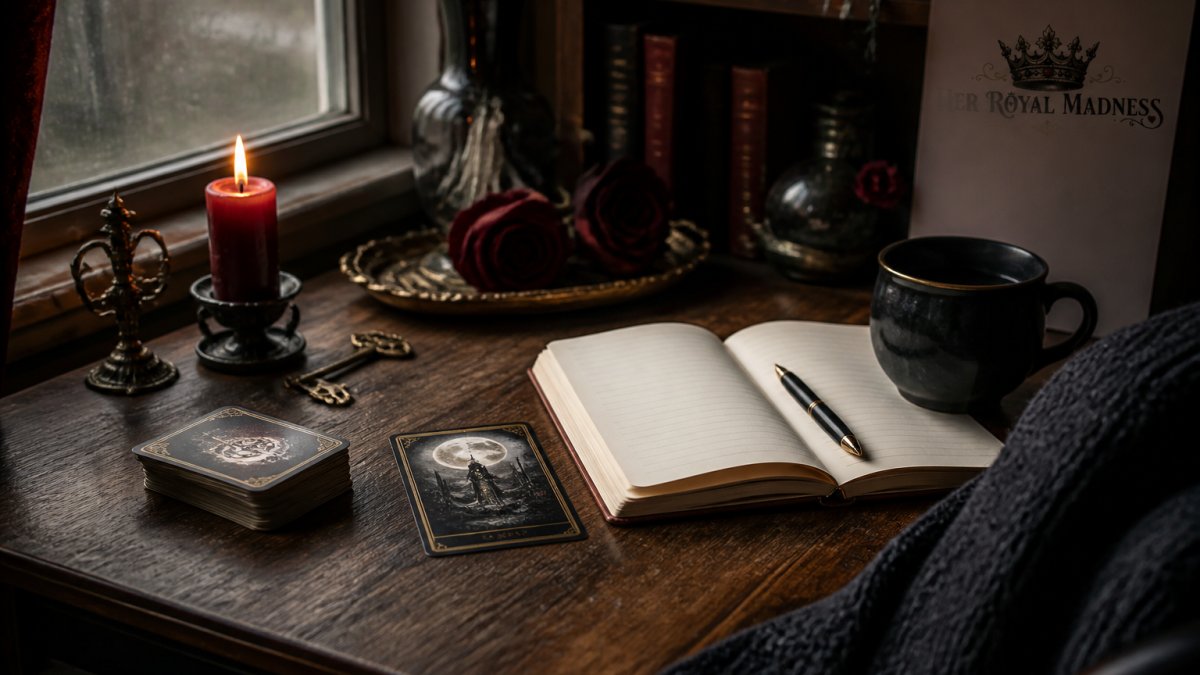
A common mistake is drawing until you get a card you like. That's not a reading. That's shopping.
Adapting the Ritual to Your Schedule
Not everyone has a quiet morning. Some of us have a 6 a.m. shift or a cat who thinks dawn is a group activity.
- Night owls: move the draw to the last ten minutes before bed. Same steps, dimmer lighting.
- Chaotic mornings: draw one card and photograph it. Journal at lunch.
- Commuter life: keep a small deck in your bag and read the card on the train.
The routine bends. It just shouldn't break entirely, the value lives in the repetition.
The One-Card Oracle Reading: Small Draw, Real Answer
A one-card oracle reading is a single draw used to answer one focused question, the best format for beginners, since fewer cards means less noise to interpret.
With one card, you can't hide behind combinations. You get one image, one keyword, one invitation, and your own reaction, far less to overthink.
Try it with a real question:
- Where should I put my energy today?
- What am I avoiding?
- What would make this week lighter?
Avoid yes-or-no questions. A card isn't a coin, and treating it like one turns a reflection tool into a slot machine.
If you want a deck that handles this format well, our Mad Queen's Oracle has a single-card mode built in, plus a journaling prompt on every card. It opens in any browser and works offline, so your morning ritual doesn't depend on Wi-Fi behaving.

Oracle Card Spreads for Beginners (Start With Three)
Three cards is the sweet spot: enough structure to feel like a reading, not enough to overwhelm you. Learn these oracle card spreads for beginners and you'll rarely need another.
| Spread | Layout | Best For | Time |
|---|---|---|---|
| One-Card Draw | 1 card | Quick daily guidance | 2 minutes |
| Past, Present, Future | 3 cards in a row | Understanding a situation | 8 minutes |
| What Was, What Is, What's Coming | 3 cards in a row | Seeing a pattern over time | 8 minutes |
| The Court | 4 cards | Questions about power and permission | 12 minutes |
The three-card row is the workhorse.
For a slightly stranger take, the Madness Oracle printable deck includes a four-card spread called The Court, built around power, performance, permission, and the audience you imagine is watching.

Oracle Card Journal Prompts for Every Kind of Day
The card starts the conversation; the journal is where it goes somewhere. But "what does this mean" gets old by Thursday. These oracle card journal prompts are organized by situation so you can grab one and go instead of staring at a blank page.
Keep your favorites on a sticky note inside your journal. Three prompts you actually use beat thirty you never open.
Morning Prompts (2-3 Minutes)
Use these right after your draw, before the day gets loud.
- What is this card inviting me to notice before noon?
- If today went gently, what would that look like?
- What's one thing I can do in the next hour that matches this card's energy?
Decision-Making Prompts (3-5 Minutes)
For the days with a real choice on the table, a conversation, a yes, a no.
- What does this card suggest I'm not seeing about the situation?
- If I trusted this card completely, what would I do next?
- What's the cost of the safe choice here?
A note on boundaries: a card can help you think, but it can't decide for you. For money, health, legal, or safety questions, it's a journaling companion, not an advisor, clarify your thinking, then consult a qualified professional.
The Mad Queen's Oracle – Interactive Digital Oracle Deck | 33 Gothic Cards →
Emotional Check-In Prompts (3-5 Minutes)
When the feeling arrived before the words did.
- What is this card asking me to look at gently?
- What part of this worry is mine to carry, and what part isn't?
- Where do I feel this in my body right now?
Evening Reflection Prompts (2-3 Minutes)
A short close to the day, especially if your draw happened at sunrise.
- Where did this card show up in my day, if at all?
- What did I handle better than I expected?
- What am I setting down before I sleep?
Prompts for the Days When Everything's Fine
These are the sneaky ones. Good stretches can feel suspicious, and that's worth writing about.
- What am I not letting myself enjoy?
- What would it look like to trust this good stretch?
- Who or what helped make today easier?
Prompts for When a Card Annoys You
That last set is the useful one. A card that irritates you is doing its job. Write about the irritation, not the card.
- Why did this one land badly?
- What's the truth in it that I'd rather not admit?
- If I'm wrong about this card, what would that mean?
How to Cleanse Oracle Cards (and When It Actually Matters)
Cleansing is a traditional practice, not a requirement, and how to cleanse oracle cards depends on your beliefs and your deck's materials.
Traditional methods include:
- Passing the deck through incense smoke
- Resting crystals on top of the deck overnight
- Knocking on the deck three times
Our honest take: cleanse when the deck feels heavy to you, not on a schedule someone else invented.
One practical note for printable decks: paper and moisture don't get along, so skip anything damp. And if you print your own, don't burn anything near them.
When the Card Makes No Sense, or Feels Bad
A confusing card isn't a broken card. It usually means the question was vague, the deck's language doesn't match yours, or you're reading the guidebook instead of the image.
Try these in order:
- Describe the artwork out loud. Literally. "There's a moth. It's very close to a flame." Sometimes the meaning arrives mid-sentence.
- Check the shadow side. Many decks list an upright and a reversed meaning. The uncomfortable one is often the accurate one.
- Re-ask the question more specifically. "What do I need to know about my job" is fog. "What do I need to know about the conversation on Thursday" is a doorway.
- Leave it. Put the card on your desk and come back at lunch. Meaning often shows up late.
A card that feels negative isn't a curse. The Book of Small Magic has a working for clearing a room after a bad day, which is a more useful response than spiraling.

And if a reading ever leaves you genuinely distressed, that's not a card problem. Talk to someone qualified. Cards are for reflection and entertainment, not diagnosis.
Tracking Your Daily Draws Without Turning It Into Homework
The biggest upgrade to a daily practice is a log; the biggest reason people quit is making it too ambitious. Keep it to three fields: date, card, one line.
That's it. Not a paragraph. Not a mood wheel. One line.
- Oct 3, The Cracked Teacup. Held it together badly and that counted.
- Oct 4, The Gilded Cage. Said no to the thing I usually say yes to.
- Oct 5, The Moth. Still too close to the flame. Noted.
A Simple Template You Can Copy
If you like structure, a five-column spread in any notebook works. Keep the columns narrow so you can't overthink them.
| Date | Card | First Word | One Line | Later Note |
|---|---|---|---|---|
| Oct 3 | The Cracked Teacup | Tired | Held it together badly and that counted. | Felt better by Friday. |
| Oct 4 | The Gilded Cage | Restless | Said no to the thing I usually say yes to. | The no was fine. |
| Oct 5 | The Moth | Warned | Still too close to the flame. Noted. | Burned out by Wednesday. |
The "Later Note" column is the secret weapon. Fill it in a week or a month after the draw, once you know how things turned out, that's where a daily habit becomes real self-knowledge instead of a stack of forgotten cards.
How to Review Your Log (10 Minutes a Month)
Once a month, read the whole log in one sitting, ten minutes, one warm drink, no phone. Look for three things:
- Repeat cards. Which cards keep appearing when you're tired, anxious, or excited? A card that shows up three times in a month is telling you something about your season, not your Tuesday.
- Repeat questions. Which questions do you keep asking without ever answering? That's usually the real work.
- Repeat words. Scan your "First Word" column. If "fine" shows up eleven times, that's a pattern worth a longer journal entry.
Adapting the Log to Your Style
- Paper people: a small notebook dedicated to draws only. Keep it with the deck so it's one motion, not two.
- Digital people: a notes app with one entry per day, tagged by card name. Searchable, which makes monthly reviews faster.
- Photo people: snap the card and type one line in the caption. Your camera roll becomes the log.
When the Log Feels Like a Chore
It will, eventually. That's normal. When it does, drop to one word a day for a week. The habit matters more than the depth. You can always write more later, you can't reread a log you stopped keeping.
Some days the draw is profound. Most days it's a small nudge. Both count. The court doesn't demand a coronation every morning.
Frequently Asked Questions
How many oracle cards should you pull each day?
One is plenty for most people, and it's the easiest habit to keep. A single card gives you one idea to carry through the day instead of five you'll forget by lunch. If you want more, a three-card spread is the natural next step: past, present, and what's coming, or situation, action, and outcome. Save the bigger spreads for weekends or specific questions. Pulling ten cards every morning tends to produce noise rather than guidance, and it makes the daily practice feel like a chore.
How long should a daily oracle card reading take?
Five to ten minutes covers it. A simple version: one minute to shuffle and settle, one minute to draw and look at the imagery, three to five minutes to write a line or two in your journal, and a minute to close out. The whole thing fits before your coffee finishes brewing. Longer readings aren't better readings; consistency is what builds the habit. If you only have two minutes, draw a card and name one word for how it lands. That still counts.
Should you cleanse oracle cards before or after using them?
Either works, and honestly, neither is mandatory. Traditional practice favors cleansing a new deck before its first reading, then again after a heavy or emotional session, or whenever the cards feel stale to you. Many readers cleanse at the start of each week rather than every single day. Simple methods include knocking on the deck, passing cards through smoke, setting them under moonlight, or simply shuffling with a clear intention. Treat cleansing as a reset ritual, not a rule you can break.
Can you use oracle cards for journaling?
Yes, and it's the fastest way to get more out of a deck. Many oracle cards, including digital and printable decks, come with a prompt on each card, which gives you a starting question instead of a blank page. If yours don't, write the card's keyword at the top of the page and answer three things: where you noticed that theme today, what it reminded you of, and one small action it suggests. Oracle card journal prompts turn a quick draw into a record you can look back on.
Ten quiet minutes, one card, and a sentence in a notebook. That's the whole practice, and it's yours to shape however you like. If you'd rather not build it alone, our gothic and witchy gifts collection has decks, journals, and small strange things to keep your ritual company. Curiosity is encouraged. Long live the madness.
