

How to Style Subtle Dark Academia Decor at Home
Last Updated: November 1, 2026
Quick Summary
Subtle dark academia decor works best when you start with one dark anchor, one warm neutral and one accent, using matte finishes and warm lamps. Style a single bookshelf first by clearing it, anchoring with books, layering objects, adding art and editing ruthlessly. Secondhand finds keep the look affordable.
- Pick one dark anchor, one warm neutral and one accent color for the palette.
- Choose matte or eggshell finishes so dark colors feel soft instead of glossy.
- Let warm neutrals carry about 60 percent of the room, with dark tones at 30 percent.
- Style shelves in order: clear, anchor with books, layer objects, add art, then edit.
- Shop thrift stores and estate sales first for wood furniture, hardcovers and wool throws.
Table of Contents
- What Subtle Dark Academia Really Looks Like
- Choosing a Dark Academia Color Palette That Stays Soft
- Building a Dark Academia Bookshelf Styling Focal Point
- Layering Textiles, Art, and Lighting Step by Step
- Dark Academia Decor on a Budget: Secondhand First
- Dark Academia Decor for Small Spaces Without the Gloom
- Your Next Move: Start One Shelf and Build From There
- Frequently Asked Questions
Dark academia is having a moment, and honestly, we're thrilled about it.
This guide shows you how to style subtle dark academia decor at home, even if your space is small, bright, or rented. Along the way we'll share a practical method, a few budget-friendly sources, and the mistakes we see most often.
What Subtle Dark Academia Really Looks Like
Subtle dark academia is the quiet version of the look. Think scholarly charm rather than candlelit gloom.
We like to think of it as a collected look. Nothing feels bought all at once. Each piece looks like it was found, inherited, or saved up for.
Dark academia works best when it stays in conversation with the rest of your home.
Choosing a Dark Academia Color Palette That Stays Soft
Color sets the mood faster than anything else, and it's also where most people overcorrect.
Here's our rule of thumb: pick one dark anchor, one warm neutral, and one accent. Use the dark color on a single wall, a bookcase, or a rug. Balance it with cream linen or pale wood so the room still breathes.
Read the Undertone Before You Commit
Dark colors carry undertones that decide whether a room feels warm or cold. A forest green with a yellow undertone reads cozy and scholarly; the same green with a blue undertone reads cooler and more formal. Chocolate brown with red undertones feels like old leather; brown with gray undertones feels like stone. Before you buy a gallon, grab a few paper swatches and tape them to the wall you plan to paint.
Finish Matters More Than You Think
Matte and eggshell finishes absorb light and give dark colors a soft, velvety depth, exactly the effect this look wants. Gloss reflects light back at you, which can make a small room feel like a cave and highlight every imperfection in the wall. For trim and built-ins, a satin finish holds up to handling while still staying soft.
The 60-30-10 Split, Adjusted for Dark Academia
Most interior designers work from a 60-30-10 ratio: 60 percent dominant color, 30 percent secondary, 10 percent accent. For this aesthetic, flip the instinct. Let your warm neutral, cream, oatmeal, pale linen, carry the 60 percent so the room stays livable, give your dark anchor the 30 percent, and reserve the 10 percent for a metallic or jewel-tone accent like antique brass, oxblood, or deep plum. That ratio is what keeps a dark palette from swallowing a room.
Test Before You Commit
Painting one accent wall is the easiest way to test the look, and it's reversible if you rent or change your mind. Choose a matte finish for a soft, velvety effect. If you're not ready to paint, a large dark rug, a dark slipcover, or a single painted bookcase delivers the same anchor with none of the commitment.
Where the Palette Goes Wrong
The most common mistake is stacking too many darks in one room. Charcoal walls, a brown sofa, a black bookcase, and a dark rug together leave the eye nowhere to rest. Pick one dark surface to lead and let the rest of the room stay in warm neutrals and mid-tones. The second mistake is ignoring the ceiling, a dark wall under a bright white ceiling can feel top-heavy.
Building a Dark Academia Bookshelf Styling Focal Point
A bookshelf is the heart of this aesthetic, and it's also the piece most people get wrong. The good news: styling a shelf is a process, not a talent. Work through it in order and even a single shelf can carry the whole mood.
Step 1: Clear and Assess
Empty the shelf completely. Look at what you actually own before you buy anything. Most people already have enough books, frames, and small objects to style one shelf well, they just haven't arranged them with intention. Sort into three piles: books, objects, and "maybe." The maybe pile goes in a box for a week; if you don't miss it, it doesn't belong on the shelf.
Step 2: Anchor With Books
Books do the heavy lifting. Mix three arrangements: a stack of three to five hardcovers laid flat, a row of upright books, and a few leaning at a slight angle.
A common pattern among people who style shelves well: roughly 60 percent books, 30 percent objects, 10 percent empty space. That last number is the one people skip, and it's the one that makes a shelf look curated instead of crammed.
Step 3: Layer Objects by Height and Weight
Objects should feel like they were collected, not purchased as a set. Work in odd numbers, three or five objects per shelf, and vary height so the eye moves. A tall brass candlestick next to a low stack of books next to a small framed sketch creates rhythm. Heavy pieces go low; delicate pieces go high.
Object categories that fit the look:
- Scholarly: a vintage globe, a brass magnifying glass, a small bust, a stack of loose letters tied with twine
- Natural: a dried botanical, a single crystal, a small dish of acorns or pinecones
- Textural: a leather-bound journal, a folded linen cloth, a small ceramic bowl
- Personal: one object with a story, a found photograph, a souvenir, a small curiosity
Step 4: Add Art and Vertical Interest
Lean a small framed print against the back of the shelf rather than hanging it. Layer a frame behind a stack of books so it peeks out. For a handmade touch, this dark academia witchy art supplies DIY kit lets you add tactile, crafted objects to your styling. Our Mad Queen's Gallery Collection™ prints work well here because the moody, storybook feel reads as collected rather than coordinated.
Step 5: Edit Ruthlessly
Step back and remove one thing. Then remove one more. The shelf should feel like it has room to breathe. If an object doesn't feel like it belongs in a study or library, it can probably live somewhere else. The rule is simple: if you can't explain why a piece is there, it isn't earning its spot.
The Witching Hour | One-of-a-Kind Gothic Curiosity Cabinet No. 001 Miniature →
Scaling Beyond One Shelf
Once one shelf works, repeat the process on the next. Keep the palette consistent across shelves so the whole bookcase reads as one piece, and repeat one or two object types, a brass accent, a crystal, a framed print, to create visual rhythm. A bookcase styled this way becomes the focal point the rest of the room can build around.
Layering Textiles, Art, and Lighting Step by Step
This is where the room starts to feel finished.
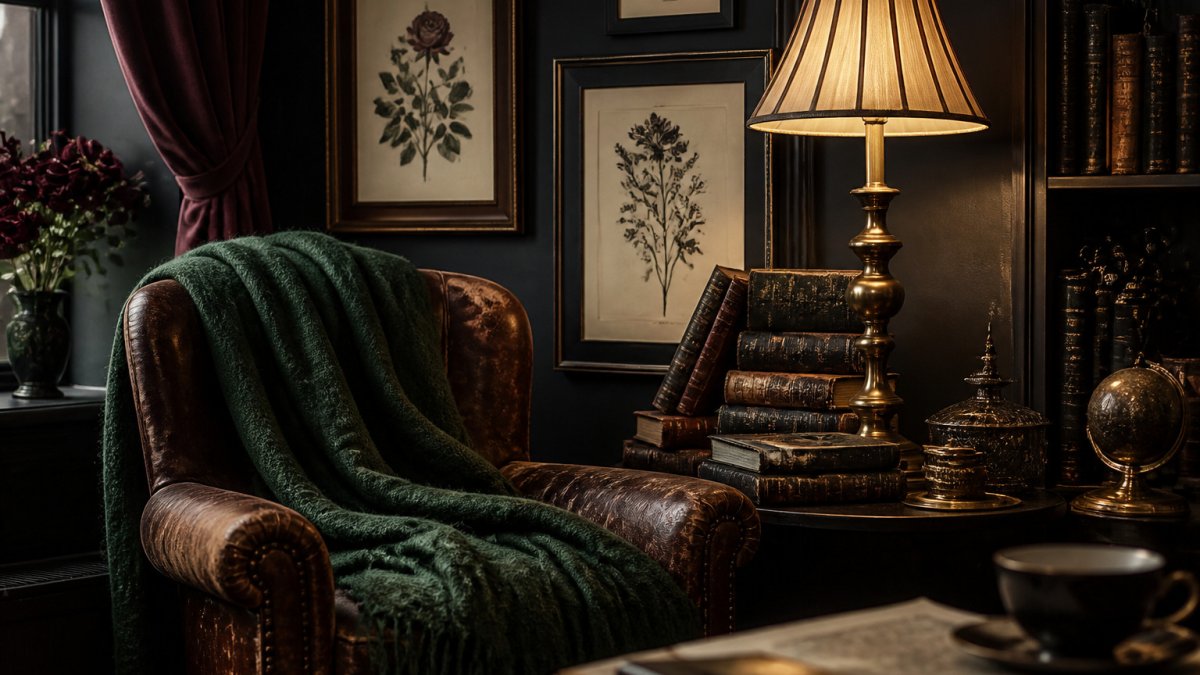
Step 1: Start with your largest soft piece. Pick a rug or curtain in a deep, muted tone.
Step 3: Hang your art. Choose framed pieces that suit the mood, then move to the next two subsections for specifics.
Step 4: Light it from low and warm. Use table lamps rather than overhead lights.
Framed Art and Botanical Prints
Framed art anchors the wall and gives your eye somewhere to land. Botanical prints, old-style portraits, and scholarly sketches all fit the look.
Group three or four frames together for impact. You can browse a set of gothic fantasy art prints with the same moody, botanical-and-academic feel. Keep frames in similar finishes, like black, dark wood, or antique gold, so the set reads as deliberate. Our Mad Queen's Gallery Collection™ prints, which include a set of four gothic fantasy art prints, can anchor a gallery wall with that same moody, storybook feel.
Rugs, Wool Throws, and Warm Lamps
Soft layers do more than look nice. They absorb sound, which makes a room feel calmer and more lived-in.
Pick a rug that covers the front legs of your main seating. A plaid or wool throw adds texture you can see and touch.
Here is a quick reference for the layering order and what each layer does for the room.
| Layer | What to do | Why it helps |
|---|---|---|
| Largest soft piece | Choose a rug or curtain in a deep, muted tone | Adds warmth and grounds the room |
| Movable textile | Drape a wool throw or heavy-weave cushion | Adds texture you can see and touch |
| Framed art | Group three or four frames in similar finishes | Anchors the wall with a deliberate look |
| Lighting | Use table lamps with warm bulbs | Makes dark colors glow instead of sulk |
Dark Academia Decor on a Budget: Secondhand First
You do not need to spend a fortune on this look. For affordable, on-theme accents you can buy new, browse this handmade dark academia journals guide for a curated look at journals that fit the style.
Start your search with these:
- Used bookshelves and side tables with real wood grain
- Hardcover books bought by the pound at thrift shops
- Vintage frames you can repaint or re-glaze
- Wool blankets and plaid throws in good condition
- Brass or ceramic lamps you can rewire for a few dollars
When you do buy new, spend on the pieces you touch most, like a good throw or a sturdy lamp. If you want a head start on the curiosities that give a shelf its story, our Unique Gifts & Curiosities are a fun place to browse.
Dark Academia Decor for Small Spaces Without the Gloom
Small or bright rooms need a lighter hand.
Try a dark accent on one piece, like a bookcase, a door, or a single chair, rather than on every wall.
If your windows are small, sheer curtains in a warm neutral keep daylight flowing while still adding softness.
For rented spaces, lean on removable options.
Your Next Move: Start One Shelf and Build From There
You don't have to redo your whole home in one weekend. Start with one shelf. Style it, live with it for a week, then decide what the next piece should be. That slow build is what makes the look feel earned.
If you're ready to start collecting, explore our curated pieces at Her Royal Madness, where you'll find gothic prints, paper goods, and little curiosities that fit right into a dark academia space. Browse the Mad Queen's Gallery Collection™ for framed-art inspiration, or explore our Queen's Treasury for more ways to bring the madness home.
Frequently Asked Questions
How do you decorate in a subtle dark academia style?
Start with a muted base of warm neutrals and deep greens, then add two or three scholarly anchors such as an old book stack, a vintage globe, or a framed botanical print. Keep the palette tight, layer one or two textiles like wool or plaid, and use warm lamp light instead of overhead fixtures. The goal is a room that feels collected and quietly intellectual rather than dramatic. At Her Royal Madness, our Mad Queen's Gallery prints work well as a restrained starting point for a gallery wall.
What colors work best for dark academia decor?
Deep forest green, dark charcoal, warm brown, and aged cream form the backbone of most subtle dark academia spaces. Pair these with brass or aged metal accents for warmth. Avoid pure black walls in small rooms, since they can feel closed in. A painted accent wall in a muted green gives you the mood without overwhelming the space.
Can dark academia decor work in a small or bright room?
Yes, if you use the darkness sparingly. Choose one darker element, like a painted accent wall, a bookcase, or a heavy throw, and keep the rest of the room light. Let natural light do the work by leaving windows unobstructed and choosing sheer curtains under the heavier drapes. Visual breathing room matters more than the number of dark pieces you own.

