

How to Start an Art Journal: A Beginner's Guide
Table of Contents
- What You'll Need to Start an Art Journal
- Choosing Your Journal Format
- Art Journaling Supplies for Beginners
- Creating Your First Page: A Complete Walkthrough
- Art Journal Ideas for Beginners
- What to Write in an Art Journal
- Using Art Journal Prompts to Overcome the Blank Page
- Building a Regular Practice and Handling Imperfection
- Frequently Asked Questions
Last Updated: October 10, 2026
What You'll Need to Start an Art Journal
To start an art journal, you don't need expensive supplies or advanced artistic skills. The barrier to entry is lower than most people think. Countless creators begin their journaling journey with just a few basic materials and a willingness to experiment.
The key is matching your supplies to your budget and style. Some people thrive with minimal tools. Others want variety from day one. Either approach works, what matters is that you actually start.
Budget-Friendly Starter Setup
You can begin an art journal with supplies you already own. Grab a notebook, some pens, and markers. Add old magazines for collage. That's genuinely enough to create meaningful pages.
If you want to invest slightly more, here's a realistic breakdown:
Under $25 starter kit:
- Basic sketchbook or mixed-media pad
- Pencils and erasers
- Ballpoint or gel pens
- Markers or colored pencils
- Scissors and glue stick
- Old magazines or printed images for collage
$25-$50 expanded kit:
- Quality mixed-media paper pad
- Watercolor set or acrylic paints
- Brushes (basic set)
- Collage materials bundle
- Washi tape or decorative tape
- Stickers or ephemera
$50+ complete setup:
- Premium watercolor paper or specialty paper pack
- Full watercolor palette or acrylic set
- Professional brush set
- Ink pens and markers
- Specialty papers and textures
- Decorative elements and mixed-media supplies
The Her Royal Madness Co. Tiny Craft Pack Ephemera collection offers hand-selected scrap materials starting at $13, perfect for collage and mixed-media work without breaking the budget. Many creators find that mystery craft packs provide enough variety to experiment without overthinking material choices.

Paper and Medium Compatibility
Not all paper works equally well with every medium. Understanding basic compatibility saves frustration and wasted supplies.
Watercolor and ink washes need heavier paper (140lb/300gsm minimum). Standard notebook paper will buckle and tear. Watercolor paper has a textured surface that holds water and pigment beautifully.
Acrylic paint and mixed media work on versatile surfaces. Cardstock, watercolor paper, and mixed-media pads all accept acrylics well. The paint dries fast and adheres to most surfaces.
Markers and colored pencils work on lighter paper (80-100lb). They don't require heavy weight because they don't add moisture. Standard sketchbook paper is perfectly fine.
Collage and layering benefit from medium-weight paper (100-140lb). Thin paper tears easily when you're gluing multiple layers. Heavier stock holds dimensional elements without buckling.
The Cottagecore Luxury Designer Paper Pack includes specialty stocks chosen specifically for texture and versatility. Each pack contains watercolor paper, textured linen, and other specialty finishes, giving you real options for experimenting with different mediums without buying separate paper types.
Choosing Your Journal Format
Your journal format shapes how you create. The format determines page size, paper type, and how pages lay flat, all practical considerations that affect your actual experience.
Hardcover bound journals stay flat when open. Pages don't flip. Binding is durable for daily use. Trade-off: you can't easily remove or rearrange pages.
Spiral-bound sketchbooks lay completely flat. Easy to remove pages if needed. Spiral binding can catch on supplies and tear. Less formal aesthetic.
Loose-leaf mixed-media pads offer maximum flexibility. Add or remove pages freely. No binding constraints. Trade-off: requires a binder or folder to keep pages together.
Junk journals (handmade from repurposed materials) feel personal and experimental. Perfect for creators who embrace imperfection. Building one takes time but costs almost nothing.
Size matters too. A5 (half of standard letter size) is portable and intimate. A4 (standard letter) gives more room for expression. Larger formats encourage bold work.
Most beginners do best with a simple spiral-bound sketchbook or mixed-media pad.
Art Journaling Supplies for Beginners
Art journaling supplies for beginners should be simple, affordable, and versatile. You don't need every tool. Focus on mediums that excite you.
Essential tools:
- Scissors (regular and craft scissors for detail work)
- Glue stick and liquid glue
- Ruler or straightedge
- Eraser
- Pencil sharpener
Color mediums (choose one or two to start):
- Markers (alcohol-based or water-based)
- Colored pencils
- Watercolors
- Acrylic paints
- India ink or liquid ink
Texture and layering:
- Washi tape
- Stickers
- Rubber stamps and ink pads
- Collage materials (magazines, tissue paper, napkins)
- Ephemera (old maps, sheet music, book pages)
Optional but useful:
- Blending stumps or sponges
- Masking tape
- Spray fixative
- Gel pens or paint pens
Start with what you have. Add supplies only when you identify a specific need or want to explore a new technique. This prevents supply overwhelm and keeps costs manageable.
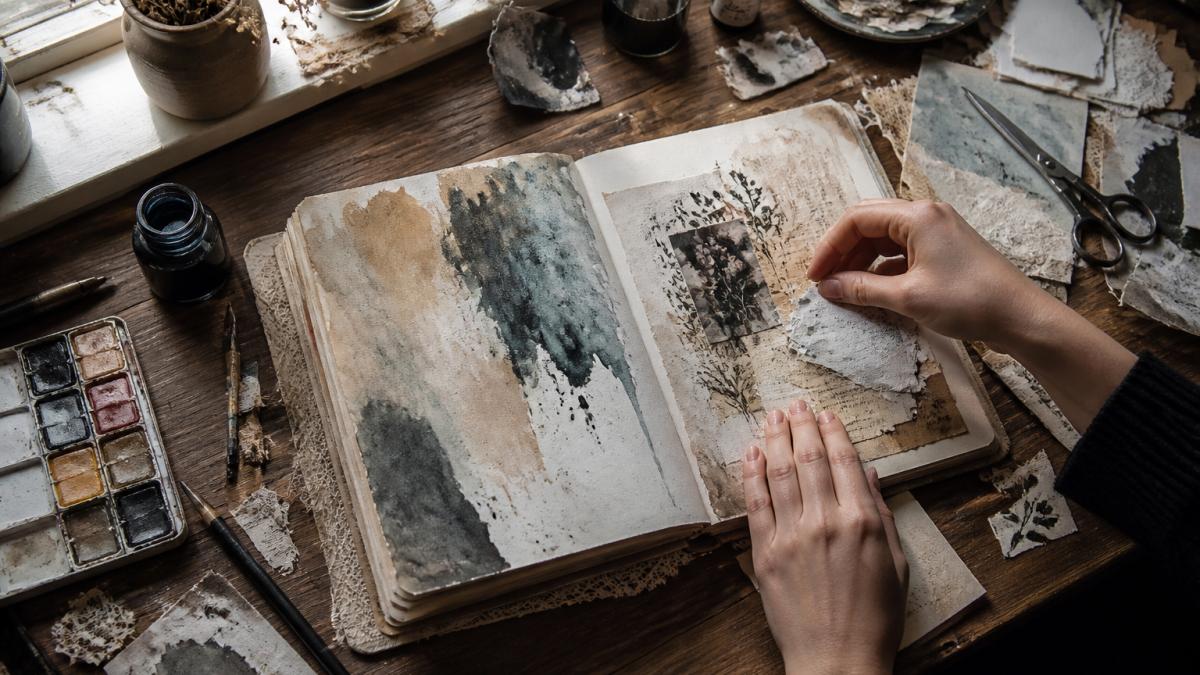
Creating Your First Page: A Complete Walkthrough
Your first page doesn't need to be perfect. It needs to exist. Here's how to create one.
Step 1: Choose your base (5 minutes) Open your journal to a blank page. Decide if you want to work on white paper or add a background color first.
Step 2: Add a focal point (10 minutes) Draw, paint, or collage something in the center of the page.
Step 3: Layer text or words (5 minutes) Add a quote, journal prompt, or meaningful phrase. Write it by hand or cut it from magazines.
Step 4: Fill empty space (10 minutes) Add decorative elements around your focal point. Draw patterns, add stickers, use washi tape, or create borders. This is where imperfection becomes charm.
Step 5: Step back and assess (2 minutes) Look at your page from a distance. Does it feel balanced? Does anything need adjusting? Add final touches if needed, then stop.
That's one complete page. It took about 30 minutes and required only basic supplies.
Art Journal Ideas for Beginners
Art journal ideas for beginners work best when they're simple enough to execute without frustration but meaningful enough to keep you engaged.
Emotion-based spreads: Create a page that represents how you felt today. Use colors, images, and words that match your mood.
Cottagecore Luxury Designer Paper Pack | 15+ Premium 4x6 Specialty Papers →
Gratitude pages: List or draw three things you're grateful for. Add images or patterns around them. This practice shifts your mindset while creating.
Collage experiments: Cut images from magazines that resonate with you. Arrange them on a page with no plan. Glue them down.
Pattern practice: Fill a page with repeated patterns, dots, lines, shapes, hatching. This builds confidence and creates beautiful texture without pressure.
Quote pages: Find a meaningful quote. Hand-letter it or write it in your own style. Decorate around it. This combines text and visual art naturally.
Seasonal reflections: Create pages that mark seasonal changes. Spring growth, summer energy, autumn release, winter rest. Tie your journaling to natural cycles.
Memory pages: Glue in a photograph or ticket stub. Write about that moment. Add visual elements that capture the feeling.
What to Write in an Art Journal
What to write in an art journal depends entirely on what serves you. There's no wrong answer. Some pages are purely visual. Others are text-heavy.
Personal reflections work well. Write about something you're processing, a challenge, a change, a realization. Don't edit yourself. This is private space.
Lists are surprisingly satisfying. Things you want to do, things you're grateful for, things you're releasing, things you're learning. Lists organize scattered thoughts into clarity.
Questions create depth. Ask yourself what you're avoiding, what you want, what scares you, what excites you.
Observations ground you in the present. Describe something you noticed today, a conversation, a color, a feeling, a moment. This trains attention.
Dreams and desires deserve space. Write about what you want to create, experience, or become. No judgment. No practicality filter.
Affirmations and encouragement matter. Write words you need to hear. Remind yourself of your strength, your progress, your worth.
Raw emotion is valid. Anger, grief, confusion, joy, whatever you're feeling, it belongs on the page. Art journaling holds what's hard to say out loud.
Using Art Journal Prompts to Overcome the Blank Page
Using art journal prompts to overcome the blank page gives your mind a starting point. Prompts eliminate decision paralysis.
Visual prompts: "Paint something that represents peace." "Create a page using only circles." "Make a collage from warm colors." Visual prompts direct your hand without requiring words.
Word prompts: "What are you afraid of?" "Describe your ideal day." "What do you need to let go of?" Words activate reflection and meaning.
Combination prompts: "Draw your current mood, then write three words that describe it." These engage both sides of your brain and create richer pages.
Timed prompts: "Spend 15 minutes on this page without stopping." Time constraints silence the inner critic. You can't overthink when the clock is running.
Constraint prompts: "Use only black and white." "Make a page using only cut paper." "Write without lifting your pen." Limitations spark creativity by removing infinite options.
| Prompt Type | Best For | Time Required |
|---|---|---|
| Visual prompts | Building confidence, overcoming perfectionism | 15-30 minutes |
| Word prompts | Processing emotions, gaining clarity | 10-20 minutes |
| Combination prompts | Deeper reflection, balanced pages | 20-30 minutes |
| Timed prompts | Quieting self-doubt, building momentum | 10-15 minutes |
| Constraint prompts | Discovering new techniques, creative breakthroughs | 15-25 minutes |
Building a Regular Practice and Handling Imperfection
Building a regular practice turns art journaling from a one-time project into a sustainable habit. Consistency matters more than perfection.
Start small. Commit to one page per week, not one page per day.
Set a specific time. Sunday evening, Wednesday lunch, Saturday morning, pick a time and protect it.
Remove barriers. Keep supplies visible and accessible.
Celebrate imperfection. Pages with mistakes, uneven lines, or "failed" experiments are often the most interesting.
Track your progress. Look back at early pages after three months. The growth is visible. This motivates continuation.
Join a community. Share pages online or with friends. Seeing others' work normalizes the messy middle and celebrates diversity of style.
Stop waiting for inspiration. Inspiration follows action. Start a page without waiting to feel ready.
Research on habit formation from Stanford Behavior Design Lab shows that small, consistent actions build lasting change faster than sporadic intense effort.
The Her Royal Madness Co. Mixed HRM Vault Digital Stickers collection provides ready-made elements for pages when you're low on creative energy.
Imperfection isn't something to overcome in art journaling, it's the point. Your handwriting is perfect because it's yours.
Art journaling invites you to slow down and pay attention to your own thoughts, feelings, and creative impulses. Her Royal Madness Co. supports this journey with curated supplies designed for experimentation, from specialty paper packs to mystery craft bundles that spark creativity without decision fatigue.

Frequently Asked Questions
Do you have to be good at art to start an art journal?
No. Art journaling is about personal expression and creative exploration, not technical skill. Beginners often find that imperfection is part of the charm. Your journal is a private space to experiment, make mistakes, and develop your style over time. Many artists discover their unique voice precisely because they gave themselves permission to be messy and unconventional.
What art journal prompts work best for beginners?
Start with prompts tied to emotion, mood, or reflection: 'How are you feeling today?' 'What color represents this week?' 'Draw something that makes you calm.' Visual prompts work too: 'Fill this page with patterns,' 'Collage images that inspire you,' or 'Paint your favorite memory.' Prompts organized by mood and time commitment help you choose what fits your day, whether you have five minutes or an hour.
What supplies do I actually need to start an art journal?
At minimum: a journal or sketchbook, pencil, and pen. From there, add what calls to you: watercolor, acrylic paint, colored pencils, markers, or collage materials like magazine cutouts and specialty paper. Paper quality matters, watercolor paper holds wet media better than regular paper. Budget packs like the Tiny Craft Pack Ephemera ($13.00) or Designer Paper Curated Gift Pack: Gothic, Celestial, Neon - Scrapbook & Journal ($29.95) offer affordable mixed media and collage materials perfect for experimentation.
How often should you work in an art journal?
There is no fixed rule. Some artists journal daily, others weekly or when inspiration strikes. Consistency builds creative habit more than frequency. Even 10 minutes once a week develops your practice. Many beginners find that regular practice, even brief, helps overcome perfectionism and builds confidence faster than occasional long sessions.
